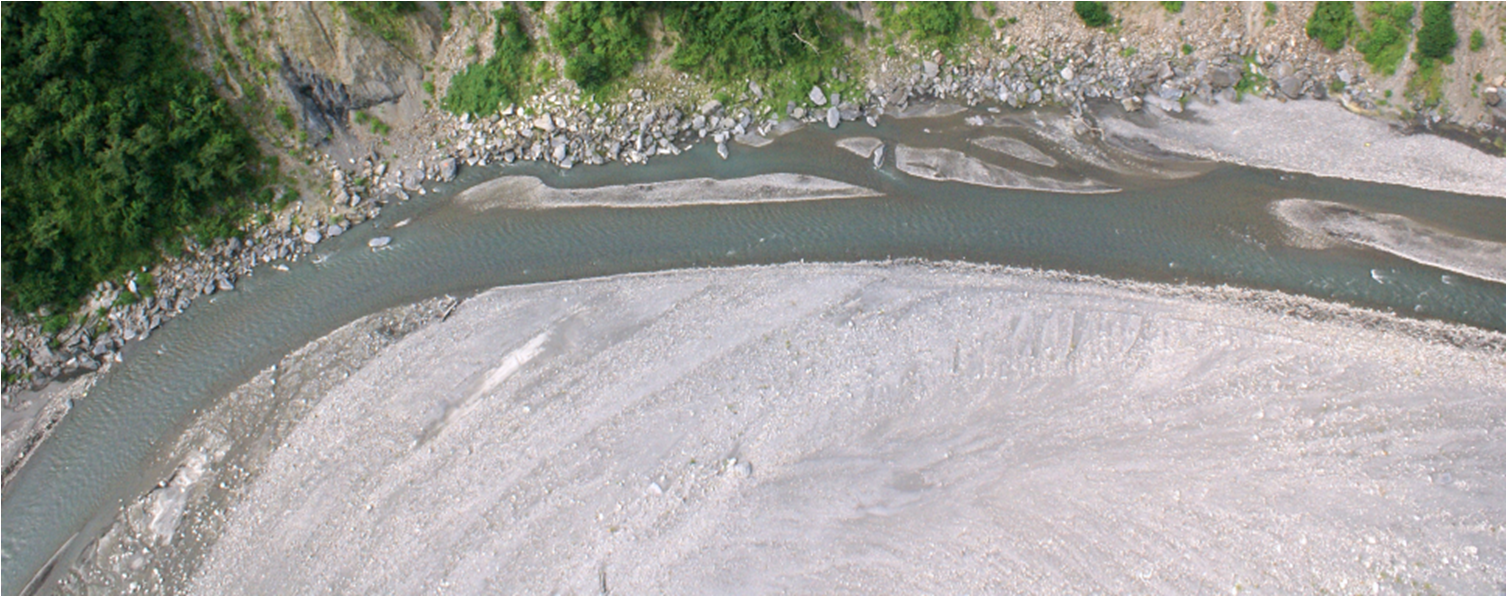
How will the coupled system of physical, biological, geochemical, and human processes that shape the surface of the Earth respond to changes in climate, land use, environmental management, and other forcings?
The above overarching question drives the research of the National Center for Earth-surface Dynamics (NCED). NCED, a Science and Technology Center established in 2002, is a partnership of research and educational institutions, government agencies, and industry that pursues its goal of predictive Earth-surface science by integrating physical, biological, and social sciences to understand how landscapes and ecosystems evolve together. The Center was developed to build our predictive ability, and therefore our scientific understanding, of the near-surface Earth environment. Through the development of this knowledge, we aim to transform management and restoration of the Earth-surface environment.
Featured Stories:
NCED at AGU 2009

NCED staff, students, researchers, and faculty will have 43 posters and 22 presentations at AGU in 2009. Additionally, NCED-affiliated individuals are responsible for convening 8 sessions! Check out the 2009 schedule of events here.
Read More
Building New Land in the Mississippi Delta - Is It Feasible?
Can coastal Louisiana’s land loss be reversed, could the land even be rebuilt? A new physically-based model developed by NCED alumnus Wonsuck Kim and principal investigators David Mohrig, Robert Twilley, Chris Paola, and Gary Parker suggests that engineered river avulsions opened below New Orleans could do just that. Using a conservative sediment supply rate and a range of rates of sea level rise and subsidence, the model predicts that between 700 and 1200km2 of new land could be built over the course of a century by diverting 45% of river flood sediment and water discharge through two new avulsions.
Read More
Braudrick and Dietrich find sand and vegetation essential for model meandering river

NCED PI Bill Dietrich and graduate student Christian Braudrick have found that vegetated banks and sand are essential ingredients in creating and maintaining a scale-model of a meandering gravel bed river in the laboratory. Braudrick, Dietrich, and collaborators have recently published their work in PNAS and have since seen it featured in National Public Radio's Science Friday Program, NSF News, and UC Berkeley Newscenter.
Read More
Using Remote Sensing to Predict How Landscape Factors Influence Ecosystem Processes

Each year in the United States, approximately $1 billion is spent to restore degraded streams. Unfortunately, the scientific understanding necessary for linking restoration actions to identified objectives is often lacking, a problem that can result in missed goals at best and environmental destruction at worst. In light of this critical knowledge gap, researchers with the National Center for Earth-surface Dynamics (NCED) are working to understand the factors that drive stream ecosystem processes in order to generate a sound base of knowledge to enable better prediction of stream response to perturbations such as restoration management, as well as changes in biota, land-use and climate.
Read More
NCED Teams With MPCA to Release Report on Minnesota River Basin Turbidity TMDL

Many of the streams and rivers in the Minnesota River watershed currently exhibit high levels of turbidity, which impairs the ecosystem of the Minnesota River, as well as that of the Mississippi River and Lake Pepin. To address the issue, the Minnesota Pollution Control Agency (MPCA) is developing a turbidity Total Maximum Daily Load (TMDL) requirement for the Minnesota River Basin, which will guide management decisions throughout the basin.
Read More
Software for Calculating Bed Load Transport Released
Together with collaborators John Pitlick and Yantao Cui, NCED Stream Restoration Program Leader Peter Wilcock has completed a project with the US Forest Service Stream System Technology Center to develop PC-based software for computing bed load transport in gravel-bed streams and rivers. The software calculates bed load transport capacities on the basis of common field measurements. It is accompanied by two reports, one describing basic sediment transport principles, the other providing instructions on software operation and guidance in the interpretation of results.
Read More
AGU Natural Hazards Focus Group Website Launched
The AGU Focus Group on Natural Hazards recently launched its new website. The Group fosters a focus on studies of geophysical hazards, including droughts, earthquakes, fires, floods, heat waves, landslides, space weather, storms, tsunamis, volcano eruptions, impact by near-Earth objects, and related events. Check out their website for information and news about the Group, as well as listings of events and resources.
Read More
Stream Restoration Symposium Arrives in Upper Midwest
NCED is a proud sponsor of the inaugural Upper Midwest Stream Restoration Symposium (UMSRS). The inaugural UMSRS will bring together leading national and regional stream restoration practitioners for presentations and discussions on important regional stream and river restoration issues. This symposium is designed to foster exchange, conversation, and new collaborations among restoration practitioners in the upper Midwest. UMSRS organizers are now accepting abstracts for poster and oral presentations. Click here for more information.
Read More
View Dietrich Langbein Lecture
NCED Principal Investigator Bill Dietrich gave the 2008 Langbein Lecture at the Fall 2008 American Geophysical Union Meeting. View a webcast of Dietrich's lecture: "Geomorphology: The Shock of the Familiar."
Read More